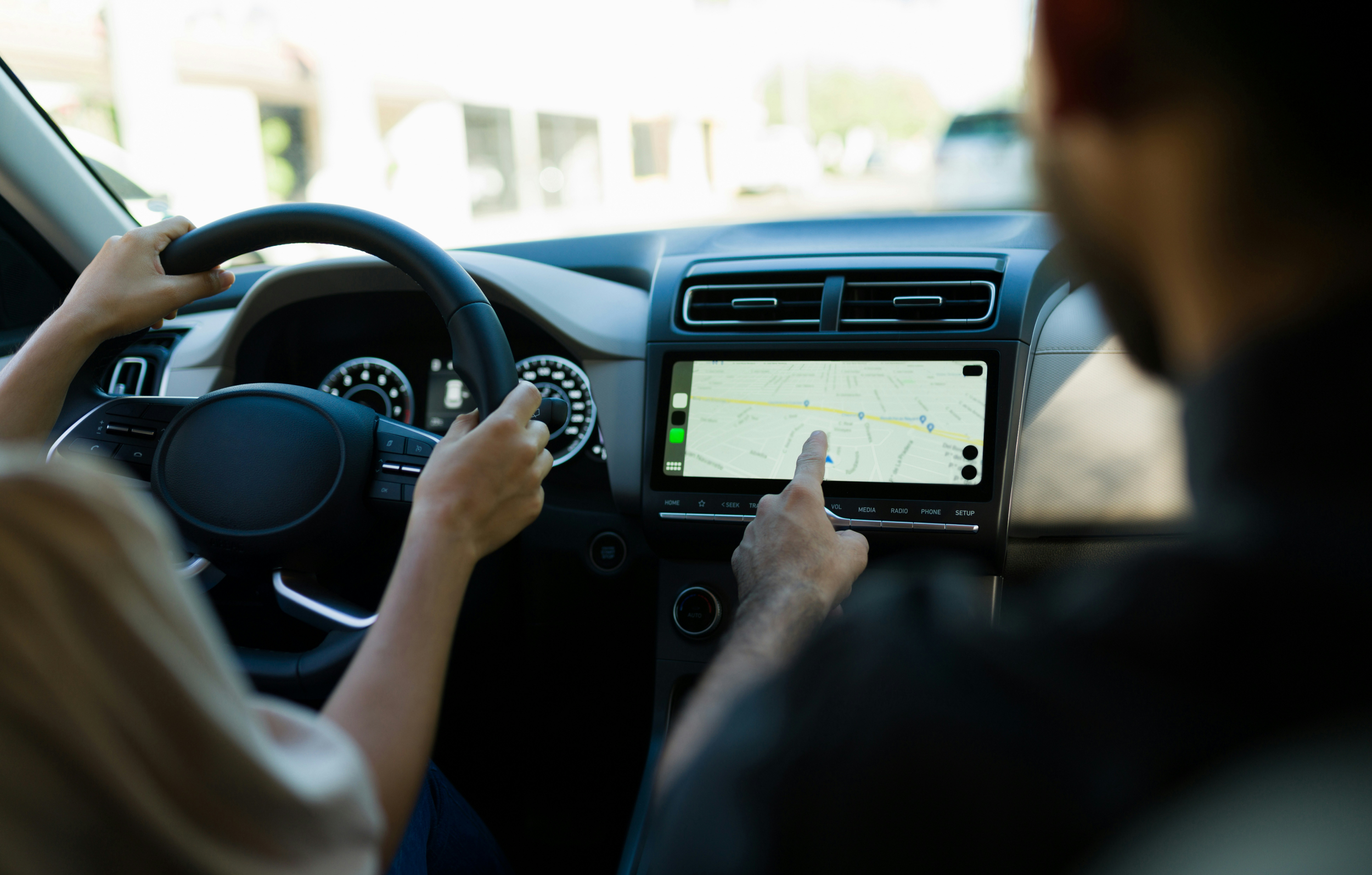
Client: International automotive engineering and testing company.
Año: 2025.
From lab to road: understanding real driver acceptance of warning systems across several European markets.
Keywords: Automotive · ADAS · DMS · Road safety · Driving experience · Online quantitative study · International research · Experiential survey.

Challenge
With new European regulations coming into force requiring in-vehicle driver monitoring systems (such as drowsiness and distraction detection), the client’s R&D team needed to go beyond simple compliance.
How willing are drivers to accept these systems and their warnings? Where is the balance between safety, comfort of use and respect for privacy?
We needed to:
Assess the acceptance of different driver warning systems.
Understand expectations and concerns around monitoring (privacy, control, intrusiveness).
Identify tolerance thresholds for the frequency and intensity of alerts.
Detect potential differences by country, age, driving experience, etc.

Methodology
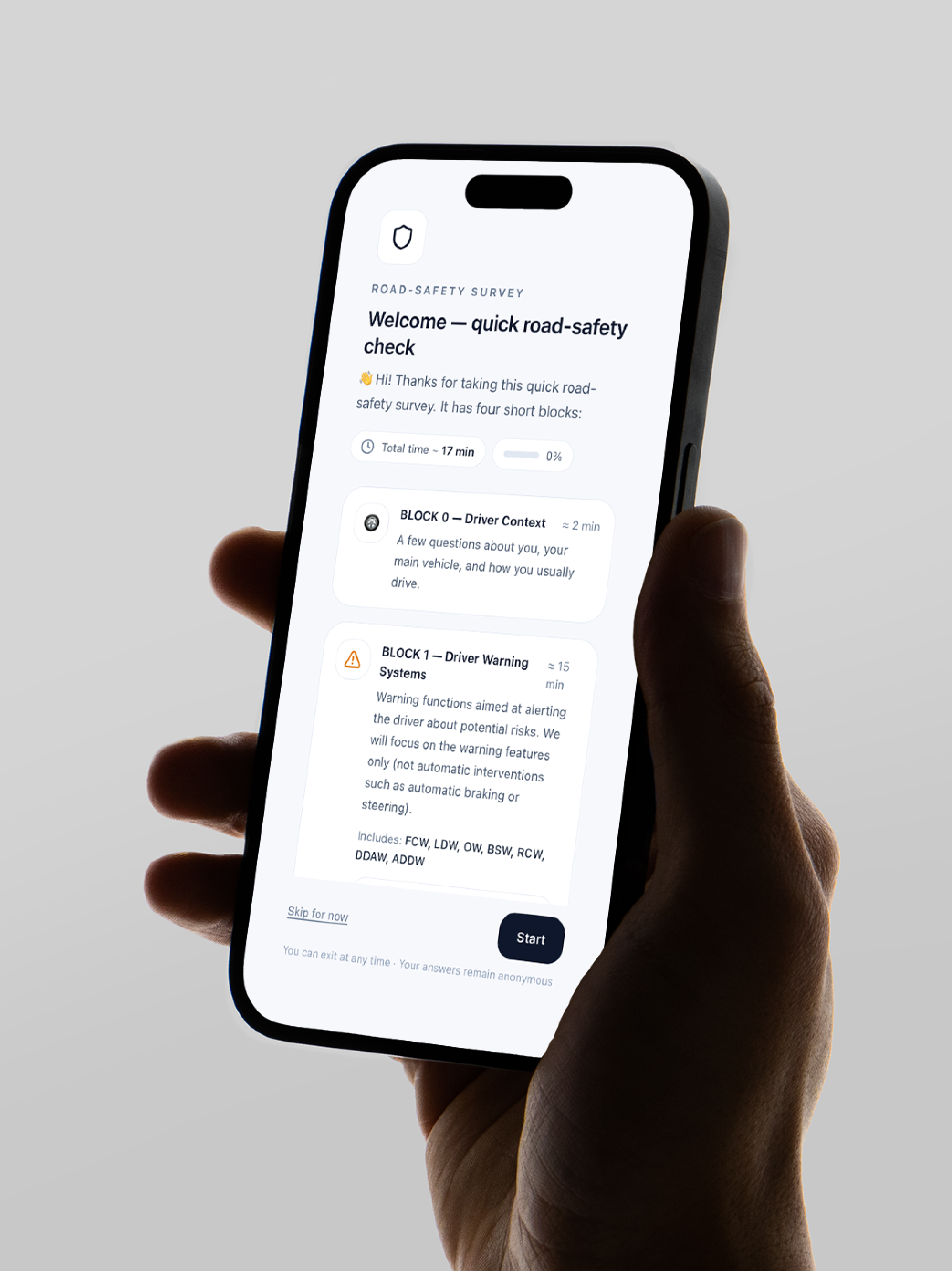
Online quantitative study (~20 min) focused on 7 driver warning systems (forward collision, lane departure, overspeed, blind spot, rear obstacle/collision, drowsiness and distraction).
Experiential survey with a human-centred design approach:
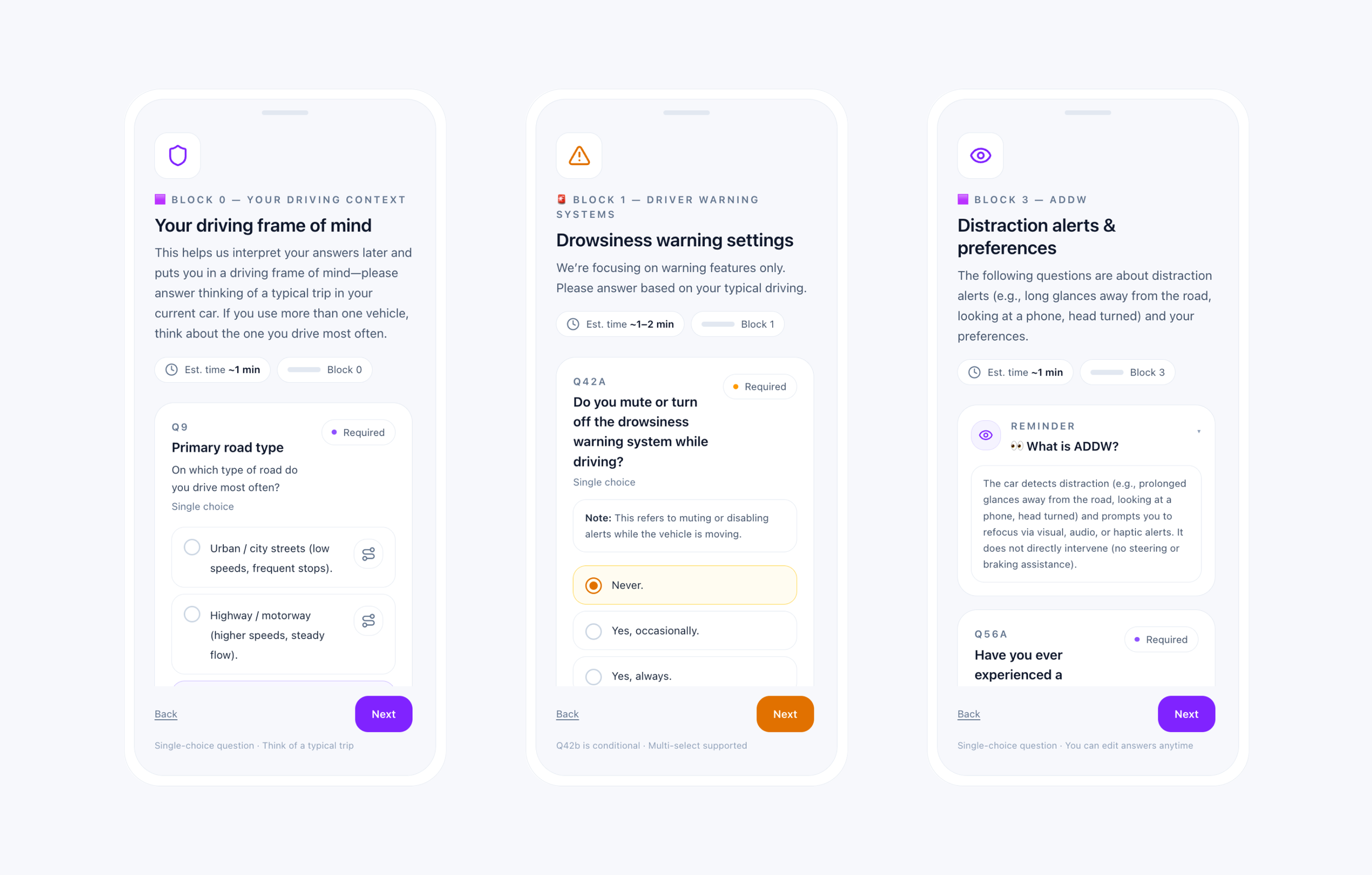
Careful wording and microcopy work to explain each system in everyday language.
Use of tooltips and contextualised examples to help people imagine real driving situations and reduce technical jargon.
Question design aimed at minimising bias and encouraging more natural responses.
Recruitment focused on an international sample segmented by country (UK, France and Germany), age, driving experience, vehicle brand, main type of road they usually drive on, etc.
Fieldwork operations: programming and testing of the survey in several languages; linguistic and cultural adaptation of items to ensure understanding and comparability between countries; data quality control and delivery in a format compatible with the client’s analysis systems.
Results
Comparative quantitative model for 7 warning systems (FCW, LDW, OW, BSW, RCW, DDAW, ADDW), measuring familiarity, perceived usefulness, trust and reasons to keep them activated or to switch them off.
International segmentation by market, driver profile and main road type, to understand in which contexts each system is perceived as more useful or more intrusive.
Actionable recommendations for the design and configuration of warnings (sensitivity, activation conditions, explanation to the user) and for communications around privacy and new regulatory requirements.
An actionable data set to feed future design and development decisions for ADAS/DMS systems.